
August 19, 2026 · 15 min read · Author: Consulting Vision
How to Manage a Marketing Agency: Governance, KPIs and Escalation
A practical CEO guide to managing a marketing agency through decision rights, KPI hierarchy, reporting cadence, escalation and handover control.
Last updated: August 19, 2026
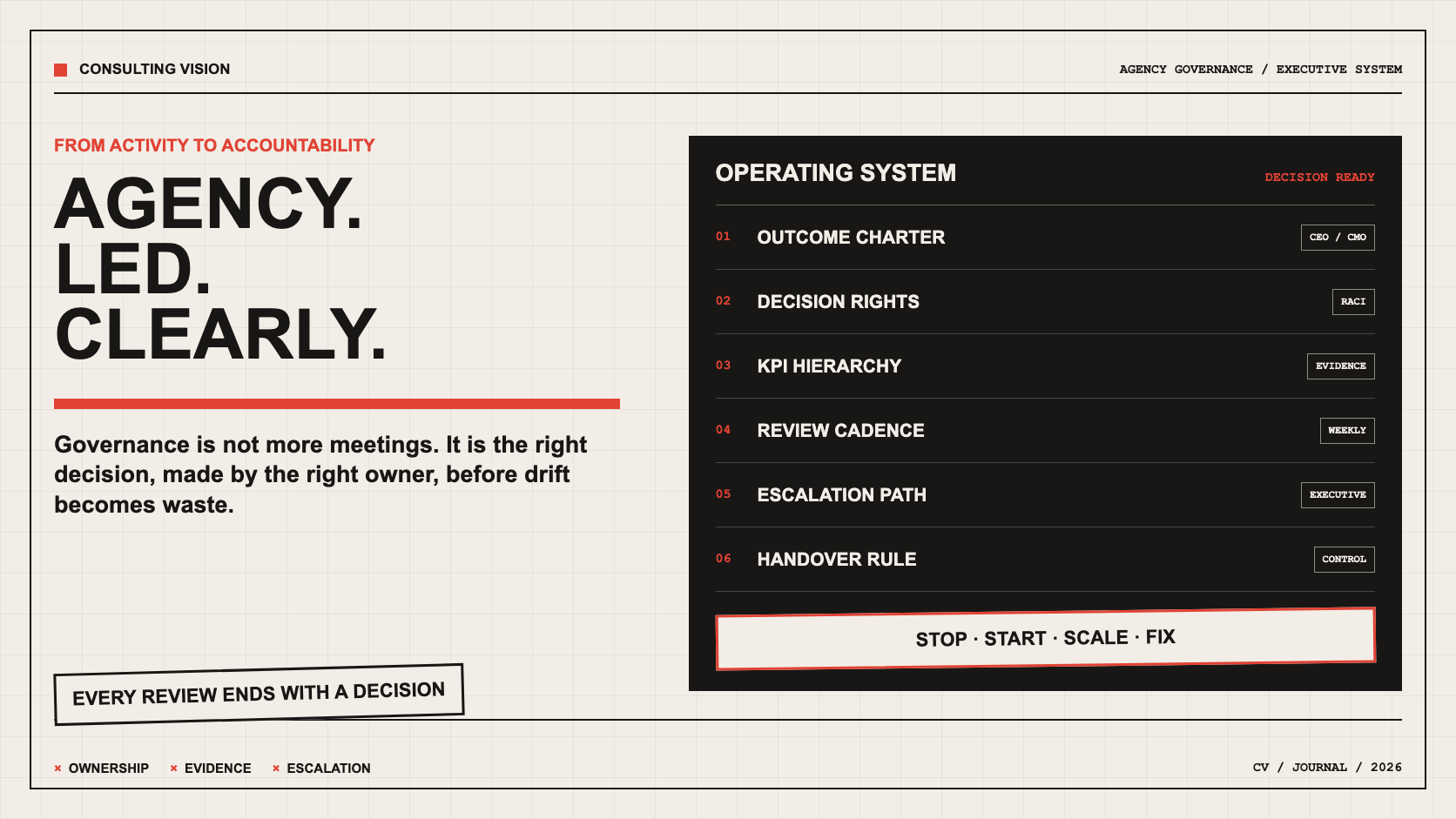
For companies with active agencies, spend and execution, but no accountable marketing owner.
What marketing agency governance actually means
Marketing agency governance is the operating system that connects an external partner's work to company decisions. It defines what outcome the mandate serves, which party can decide what, which evidence is trusted, how often performance is reviewed and what happens when delivery or results drift. It is not procurement bureaucracy and it is not constant client interference in specialist execution.
A weak relationship asks the agency to deliver growth while the company changes priorities, withholds sales data, delays approvals and never defines acceptable performance. A weak agency accepts that ambiguity, reports activity and asks for more budget. Governance makes both sides accountable for the parts they actually control.
The commercial cost of weak agency management is not theoretical. In a 2022 ANA survey, almost 60% of respondents said that inefficiencies in agency management could consume as much as 30% of their marketing budget. That is a perception-based industry survey rather than an audit of your own spend, but it is a useful warning: unclear roles, poor briefs and slow decisions can destroy value even when the agency's specialist work is competent.
| Decision area | Agency role | Company role | Accountable owner |
|---|---|---|---|
| Business objective | challenge feasibility and translate into channel implications | set the commercial target and trade-offs | CEO or marketing leader |
| Channel plan | recommend tactics, sequence and resource needs | approve fit with the wider operating plan | marketing leader |
| Campaign execution | build, launch, optimize and document | provide timely access and approvals | agency delivery lead |
| Budget variance | surface evidence and recommendation | approve material reallocation | budget owner |
| Lead quality | connect source and campaign evidence | provide structured sales acceptance feedback | marketing and sales leaders |
| Provider performance | explain variance and corrective action | accept, escalate, rescope or terminate | marketing leader or CEO |
The six documents that make an agency governable
1. Outcome charter
Write the mandate on one page: the commercial problem, confirmed baseline, target, period, scope, constraints and dependencies. Separate an outcome such as qualified pipeline from an output such as campaigns launched. State which assumptions must hold, including offer strength, sales capacity, tracking quality and approval speed.
2. Decision-rights matrix
For each recurring decision, name who recommends, who decides, who executes and who must be consulted. Avoid assigning two accountable owners. A RACI is useful only when it covers real moments: budget moves, creative approval, campaign stop, data disputes, scope changes and contract escalation.
3. KPI hierarchy
Build a hierarchy from business outcome to pipeline, funnel quality, channel performance and operational health. The agency may optimize click-through rate or cost per lead, but those numbers cannot overrule rejected leads, weak opportunity value or poor contribution margin. Agree on definitions and source systems before the first review.
4. Review cadence
Use the shortest meeting that can make the required decision. Weekly reviews handle exceptions and next actions. Monthly reviews examine trend, pipeline, budget and capacity. Quarterly reviews revisit ICP, offer, channel portfolio, agency fit and whether the current operating model still makes sense.
5. Escalation ladder
Define what happens when a deliverable is late, data is unreliable, quality falls or results miss the agreed threshold. An escalation is not an emotional complaint. It records the trigger, evidence, owner, corrective action, deadline and consequence if the correction fails.
6. Handover and access register
List ad accounts, analytics, domains, pixels, audiences, creative files, documentation and reporting sources. The company should retain administrative control of critical assets. Google states that client accounts keep their data and can unlink a manager; Meta also defines distinct roles and permission levels. Access should enable delivery without creating dependency.
| Control | Minimum content | Review frequency | Failure signal |
|---|---|---|---|
| Outcome charter | baseline, target, scope, assumptions, period | quarterly or after material change | different parties optimize different outcomes |
| Decision rights | recommend, decide, execute, consult | monthly and on role change | CEO resolves routine delivery disputes |
| KPI hierarchy | business, pipeline, funnel, channel, operations | monthly | channel metrics contradict sales outcomes |
| Decision log | evidence, decision, owner, due date, result | weekly | the same debate returns every meeting |
| Escalation register | trigger, cause, corrective action, consequence | as exceptions occur | problems age without ownership |
| Access register | asset, owner, permission, recovery path | quarterly and at offboarding | agency exit threatens data or continuity |
A review cadence that creates decisions
| Cadence | Purpose | Required evidence | Output |
|---|---|---|---|
| Weekly, 30 minutes | manage exceptions and unblock delivery | tests, variance, blockers, next evidence | one decision log with owners and dates |
| Monthly, 60-90 minutes | connect spend and work to pipeline | trend, lead quality, opportunities, budget variance | stop, start, scale and fix decisions |
| Quarterly, 90-120 minutes | revisit strategy, provider fit and resource allocation | segment performance, economics, capacity, market change | updated outcome charter and 90-day priorities |
| Incident review | resolve material risk or repeated failure | timeline, root cause, impact and corrective plan | accepted recovery plan, rescope or exit |
Do not let every meeting become a presentation. Send descriptive metrics in advance. Use live time for anomalies, competing explanations and decisions. End with a named owner, due date and evidence that will confirm whether the decision worked.
The escalation ladder: fix before you switch
- Level 0 - Clarify: resolve a single ambiguous brief, definition or approval within the working team.
- Level 1 - Correct: document the variance, root cause, corrective action, owner and short deadline.
- Level 2 - Rescope: change deliverables, staffing, cadence or budget when the existing model cannot meet the outcome.
- Level 3 - Executive review: agency and company sponsors decide whether recovery is credible and commercially justified.
- Level 4 - Handover or exit: protect accounts, data, documentation, live campaigns and organizational learning before termination.
Escalation should be symmetric. If the agency is waiting on access, approvals or sales feedback, the company-side owner must correct that failure. Governance is not a tool for shifting every commercial risk to a supplier. It makes dependencies visible so the right party can act.
Formal evaluation should also run in both directions. WFA research published in 2022 found that 68% of agencies were comfortable telling clients most of the time what the client needed to change, up from 45% two years earlier. A useful review therefore asks both sides what is blocking performance and converts the answers into owned corrective actions rather than a one-sided supplier score.
Diagnostic
Is the agency relationship governable?
0 / 7 · threshold: 5
When the missing layer is marketing leadership
An agency can govern its own delivery. It cannot neutrally own company strategy, sales behavior, final capital allocation and the performance of competing providers at the same time. When those cross-functional decisions remain with an overloaded CEO, another agency does not solve the operating gap.
Consulting Vision works as external marketing leadership or a Fractional CMO. We clarify the outcome, govern internal and external execution, connect reports to pipeline and build a handover-ready operating system. Specialist agencies remain valuable; they simply work inside one accountable direction instead of several disconnected briefs.
- giving the agency an outcome but withholding the decision rights or data required to influence it.
- using dashboards without definitions, thresholds or consequences.
- letting each channel optimize a local metric that conflicts with pipeline quality.
- changing priorities faster than the agency can complete a learning cycle.
- escalating emotionally instead of recording evidence, owner and deadline.
- allowing the agency to become the only administrator of critical assets.
- switching providers before testing whether the relationship was governable.
Related reading
- Outsourced Marketing Leadership: Cost and Scope
- Marketing Leadership Consulting
- Marketing Agency Cost and Hidden Costs
- Marketing Agency Alternatives
- Fractional CMO vs Marketing Agency vs In-House
- CMO as a Service
- External Marketing Leadership Mandate
- Marketing agency reporting: the CEO specification
- How to measure marketing agency ROI
Frequently asked questions
- What is marketing agency governance? +
- It is the system of outcomes, decision rights, evidence, review cadence, escalation and account control that connects an agency's work to company decisions.
- Who should manage a marketing agency? +
- One accountable company-side marketing leader should govern the relationship across priorities, budget, sales feedback and performance. Channel specialists can manage daily delivery inside that mandate.
- What should an agency report every month? +
- Trend versus baseline and target, lead quality, pipeline contribution, budget variance, key tests, causes of deviation, recommendation, owner and the decision required.
- Should an agency own the ad accounts? +
- The agency may receive the permissions needed to operate, but the company should retain administrative control, data access and a documented recovery path for critical accounts and assets.
- When should a company escalate agency performance? +
- When an agreed delivery, quality, data or performance threshold is missed. Record the evidence, root cause, corrective action, owner, deadline and consequence before moving to executive review or exit.
- When should we replace the agency? +
- After confirming the scope was clear, company dependencies were met and a documented recovery plan failed, or immediately when trust, data access, compliance or critical capability is irreparably compromised.
- How does Consulting Vision help govern agencies? +
- Consulting Vision acts as external marketing leadership or a Fractional CMO, owning cross-functional priorities, agency direction, budget logic, executive reporting and the operating rhythm around specialist execution.
Primary sources and operating references
- ANA: Client/agency relationship management and efficiency
- WFA: Client-agency performance evaluations, 2022 update
- WFA/VoxComm: 2025 agency selection and relationship principles
- Google Ads: Third-party transparency policies
- Google Ads: Ownership of client accounts
- Google Ads: Account security and access best practices
- Meta: Roles and permissions for advertising accounts
For companies with active execution that need one owner across agencies, team, budget and pipeline.